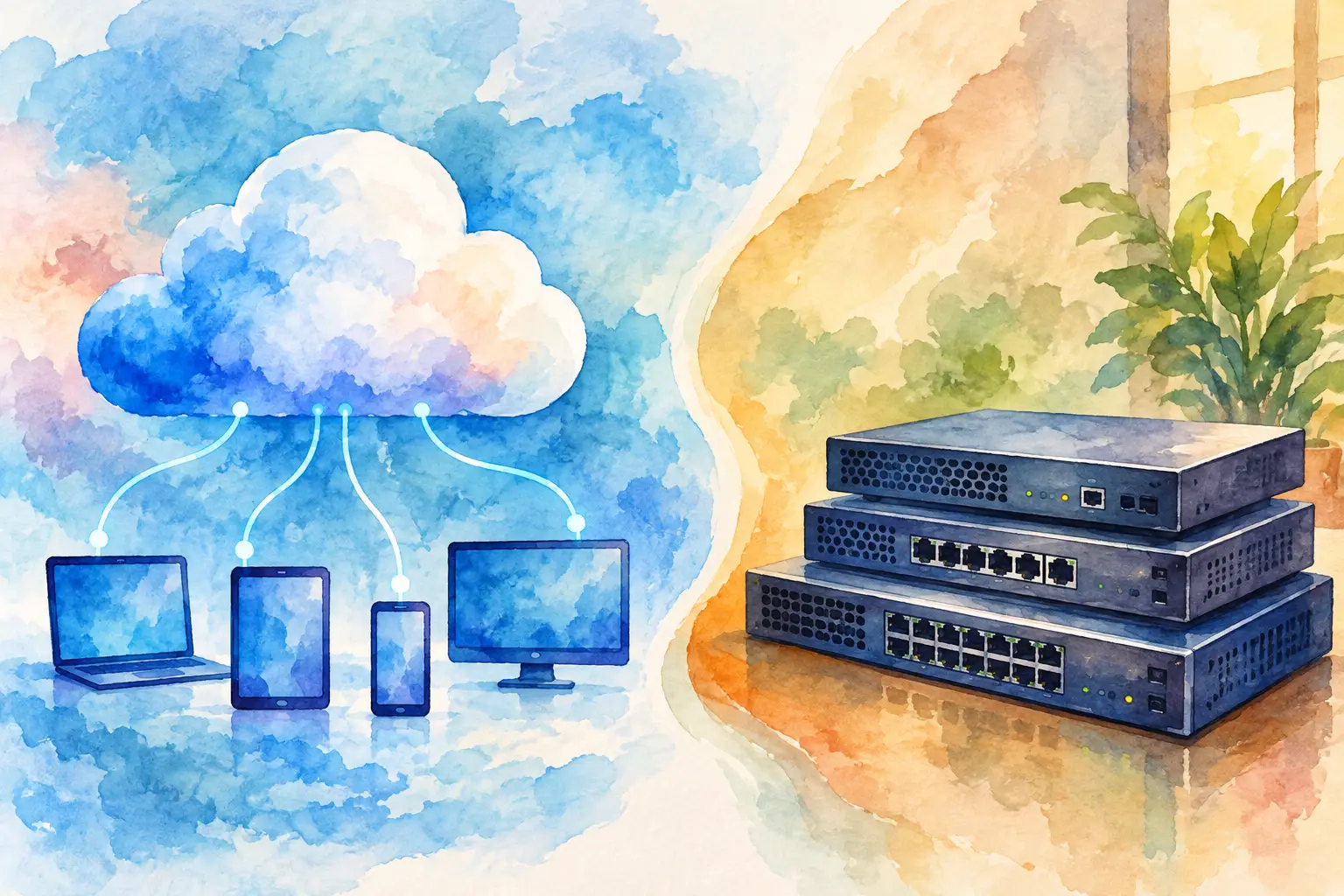
A cloud gateway versus hardware appliances decision is rarely about whether a call can be placed. Both models can connect mobile networks to SIP infrastructure. The operational difference appears when devices are distributed across sites, a route degrades at 2 a.m., a SIM loses registration, or finance needs accurate call records tied to customers and balances.
For telecom operators, VoIP providers, and systems integrators, the relevant question is where control, status, and workflow live. A fixed appliance concentrates capacity in a rack or site. A cloud-managed gateway model treats mobile-connected endpoints as a fleet, with configuration, call activity, routing context, and alerts available from a central operations workspace.
What Hardware Appliances Still Do Well
Dedicated GSM gateway appliances remain a valid choice for tightly controlled, single-location deployments. They generally provide predictable port density, fixed network interfaces, and an installation model that experienced voice engineers understand immediately. If the requirement is a known number of channels in one equipment room, with local power, cooling, and network support, an appliance can be straightforward to commission.
The physical model also has an advantage when all operational ownership is local. A technician can inspect cabling, swap a module, review indicator lights, and work within existing rack procedures. For environments with stable capacity requirements and limited need for remote device administration, that familiarity can outweigh architectural flexibility.
The trade-off is that hardware density often brings hardware dependency. Expansion may require another chassis, additional SIM interfaces, cabling work, power capacity, and a new round of provisioning. A fault can be isolated to a port, modem bank, cable, or appliance, but that isolation still depends on someone having access to the location and enough diagnostic context to act quickly.
Cloud Gateway Versus Hardware Appliances in Operations
The main distinction is not that cloud-managed endpoints eliminate physical equipment. Mobile devices, connectivity methods, power, and local networks still matter. The distinction is that the control plane is centralized rather than trapped inside individual gateway interfaces.
With a cloud gateway architecture, an operations team can view endpoint availability, signal state, active calls, registration status, operator assignment, and recent failure conditions from one place. The same workspace can align gateway status with SIP trunks, routes, customer profiles, prepaid balances, CDRs, and reporting. Instead of logging into several appliance web interfaces and comparing disconnected records, the NOC works from a shared operating view.
That changes incident response. When ASR drops or ACD moves outside its expected range, the team needs to determine whether the issue is route-specific, carrier-specific, device-specific, or caused by a SIP-side condition. Centralized call records and status telemetry do not remove the need for engineering judgment, but they reduce the time spent collecting evidence.
A hardware appliance may expose alarms and call logs, but its scope is usually the box itself. In a distributed deployment, operations must aggregate that information across locations. Cloud-managed systems are designed around the fleet from the start. This is especially relevant for organizations with endpoints in multiple cities, regional field sites, or customer-managed facilities.
Deployment Flexibility Is a Capacity Planning Issue
Fixed appliances typically dictate their connection method, port layout, and physical footprint. That can be useful when a deployment has been standardized around a specific rack design. It can also make small changes disproportionately expensive. Adding a modest amount of capacity may mean purchasing equipment sized for a larger increment, then allocating rack units, switch ports, power, and installation time.
A mobile endpoint approach can be deployed according to site constraints. USB-connected devices can support wired density where equipment is centralized. Bluetooth connectivity can suit locations where cable layout is restrictive. A purpose-built bridge can support cable-free digital wideband audio where deployment simplicity and audio path quality are priorities.
These options should not be treated as interchangeable. USB may be appropriate when a site needs a controlled physical arrangement and high endpoint concentration. Wireless connectivity may reduce local cable complexity but requires disciplined management of radio conditions and device placement. A bridge-based design may be preferable where a dependable digital audio connection is required without building a cable-heavy installation.
The planning benefit is choice. Engineering can match the connection architecture to the location instead of forcing every site into a single appliance footprint.
Visibility Matters More Than a Green Status Light
A gateway labeled online is not necessarily ready to carry useful traffic. It may have poor signal conditions, limited available balance, repeated registration failures, a SIP trunk issue, or an abnormal call failure pattern. Operators need status that can be acted on, not a generic availability indicator.
A capable cloud control plane should let teams examine the condition of individual devices alongside the voice operation around them. That includes live calls, route assignments, SIP registration, operator usage, alerts, CDR detail, and historical performance. The goal is to answer operational questions directly: Which devices are available? Which route is receiving failures? What happened immediately before a call failed? Which customer profile and balance apply to this traffic?
This visibility also improves handoff between teams. A NOC engineer can identify the technical condition, a routing administrator can adjust the relevant SIP path, and a billing or operations user can verify the commercial record without rebuilding the story from separate systems. Clear ownership depends on clear evidence.
Resilience Requires Different Thinking
Hardware appliances are often evaluated through component resilience: redundant power, spare units, replacement modules, and local network design. Those controls remain relevant. A cloud-managed fleet shifts part of the resilience conversation toward distribution. Capacity can be arranged across multiple sites, endpoint groups, and local connectivity conditions rather than concentrated in one chassis.
Neither approach is automatically more reliable. A distributed model introduces dependencies on endpoint health, local power, and internet reachability at each location. A centralized appliance model reduces the number of remote sites to manage but increases the impact of a local facility issue. The correct design depends on call volume, geographic requirements, support coverage, and acceptable recovery time.
The strongest deployments plan for observable failure. They define what should trigger an alert, who owns first response, what configuration changes are permitted, and how capacity is moved when a site or route is impaired. Cloud management helps because it makes these procedures repeatable across the fleet, but it does not replace network design or operational discipline.
Cost Is More Than the Appliance Purchase Price
Comparing acquisition cost alone produces misleading results. Hardware appliances have clear upfront pricing, but the total operating cost includes rack space, power, replacement inventory, cabling, on-site labor, firmware maintenance, and the time required to administer separate systems. Those costs grow with each new location.
Cloud-managed gateway operations shift more value toward software control and device lifecycle management. The team should still account for mobile devices, local connectivity, power arrangements, and replacement units. The financial advantage is most visible when centralized management reduces truck rolls, duplicate tools, manual reporting, and the time spent troubleshooting devices one by one.
For a small, static site, the hardware model may remain economical. For an expanding multi-site operation, the ability to provision, monitor, and control endpoints remotely can materially change the cost of scale. The deciding metric should be cost per managed, observable channel over time, not simply cost per port at installation.
Choosing the Right Architecture
Start with the operational pattern, not the equipment catalog. If traffic is concentrated in one supervised facility and capacity changes slowly, appliances may fit the environment well. If endpoints must operate across locations, if engineers need a common view of calls and device state, or if routing and billing workflows must be coordinated centrally, a cloud-managed model is usually the better fit.
GSMCalls is built around the second model: managed mobile devices operating as remotely administered SIP endpoints, with gateways, calls, trunks, routes, balances, profiles, alerts, and CDRs visible in one workspace. It can integrate into established environments using SIP with platforms such as Asterisk, FreePBX, 3CX, Kamailio, OpenSIPS, and SBCs.
Before selecting either path, run a practical design review using real failure scenarios. Ask how a team will identify a degraded device, trace a failed call, confirm route behavior, replace capacity at a remote site, and reconcile records at the end of the billing period. The architecture that gives your team the clearest answers under pressure is the one worth deploying.