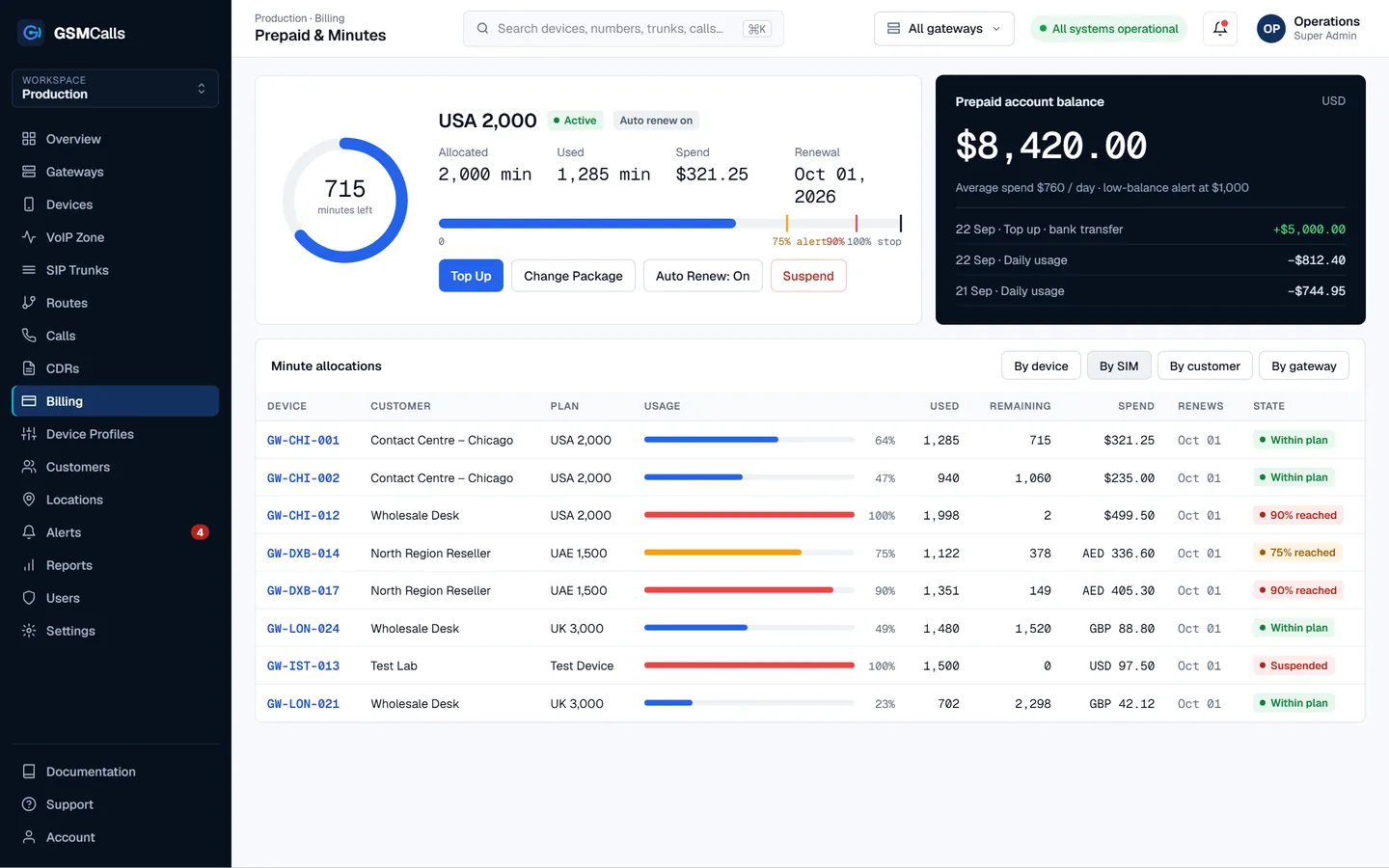
A cloud GSM gateway is managed from a hosted platform rather than a box you log into on site. GSMCalls runs the control plane for you: devices, SIP trunks, routing, CDRs, prepaid minute profiles and alerts live in one web portal, while mobile phones at each site do the radio work.
Why teams choose GSMCalls as their cloud GSM gateway
No on-prem management server to patch, back up or secure
Every phone, SIM and site in one device table
SIP trunks over UDP, TCP or TLS with ACLs and failover
Prefix and group routing with CDRs for every call
Prepaid minute profiles with alerts at 75%, 90% and 100%
Flat monthly plans from $100 for up to 10 phones
What “cloud GSM gateway” means in practice
A classic GSM gateway is a chassis with SIM slots and its own web interface. Each unit is configured separately, logs stay on the box, and reporting across sites means exporting spreadsheets. In a cloud GSM gateway model, the configuration, call records and monitoring move to a hosted platform, and the devices at the edge simply connect to it.
With GSMCalls, the edge devices are mobile phones connected by Smart Bridge (no PC), Wireless Connect (Bluetooth to a mini PC) or USB Connect (wired to a gateway PC). Whatever the method, the cloud portal is where you manage them — you never maintain a management server of your own.
Portal features for cloud GSM gateway management
The portal covers the full operational loop, from registering a device to billing its minutes:
Devices — model, operator, signal, connection method, battery and minutes; bulk actions and remote restarts
SIP trunks — UDP, TCP or TLS transport, IP ACLs, codec order, OPTIONS health checks and failover
Routing — routing groups, prefix rules and per-site routes toward DIDs and outbound (DOD) destinations
CDRs — every call with billable duration, rate, cost and disconnect cause; CSV or Excel export
Prepaid billing — minute profiles per device, SIM, customer or gateway, with top-ups, suspension and auto renew
GSMCalls presents standard SIP trunks to your PBX, SBC or softswitch. Use registration or IP authentication, pick G.711 A-law or μ-law, or wideband G.722 where supported, and encrypt signalling with TLS. Integration guides exist for FreePBX, Asterisk and 3CX; the fundamentals are explained in SIP trunks, DID and DOD.
Billing and usage control built in
Mobile lines cost money per minute or per bundle, so usage control matters as much as uptime. Minute profiles cap what each device, SIM or customer can use, and telecom billing views turn CDRs into balances in the currency you sell in. When a plan is exhausted you decide what happens — block, alert or allow.
Day-to-day operations without a site visit
Most gateway problems are small and local: a SIM runs out of credit, a phone loses signal after someone moves it, a charger fails. In a cloud GSM gateway platform these show up as alerts and status changes rather than user complaints. You can see which device dropped, when, and what its last calls ended with, then restart the gateway service, move the line to another routing group or ask someone on site to swap a single phone.
Because every site reports into the same portal, the same checks work everywhere. New staff learn one interface, and a change to a trunk or routing rule is made once instead of on every box.
Security and responsibility
The management plane is hosted, so there is no management server on your network to patch and expose. Trunks can be locked to known IP addresses and encrypted with TLS. GSMCalls is intended for lawful, authorised deployments; you remain responsible for local regulations and your carriers’ terms, as set out in the acceptable use policy.
Prices in USD per month. Taxes, carrier airtime and SIM costs are not included. Features marked Coming Soon are not yet available.Compare all four plans
FAQ
Cloud GSM gateway questions
Still unsure? Talk to an engineer — we'll map your site to the right architecture.
A GSM gateway whose configuration, monitoring and call records are managed from a hosted platform rather than on each device. GSMCalls uses mobile phones at the edge and a cloud portal for control.
Do I need to host any server?
+−
No management server. Smart Bridge sites need no computer at all; Wireless Connect and USB Connect sites use a gateway PC that the portal manages.
Which PBXs does it work with?
+−
Any platform that supports standard SIP trunks over UDP, TCP or TLS, including FreePBX, Asterisk and 3CX.
What happens if the internet connection at a site drops?
+−
Phones at that site cannot carry SIP calls until connectivity returns, and the portal marks them offline and raises an alert. Routing can fail over to phones at another site or to a standby SIP trunk.
How is it priced?
+−
Flat monthly plans: Starter $100 for up to 10 phones, Professional $150 for 20, Business $200 for 30, and custom Enterprise agreements. Airtime and SIM costs are separate.
GSMCalls is built for lawful, authorised deployments. You remain responsible for local telecommunications regulations and your carriers’ terms — see the acceptable use policy.
Build Your Mobile Gateway Infrastructure
Connect a few phones or manage hundreds of devices across multiple locations from one platform.