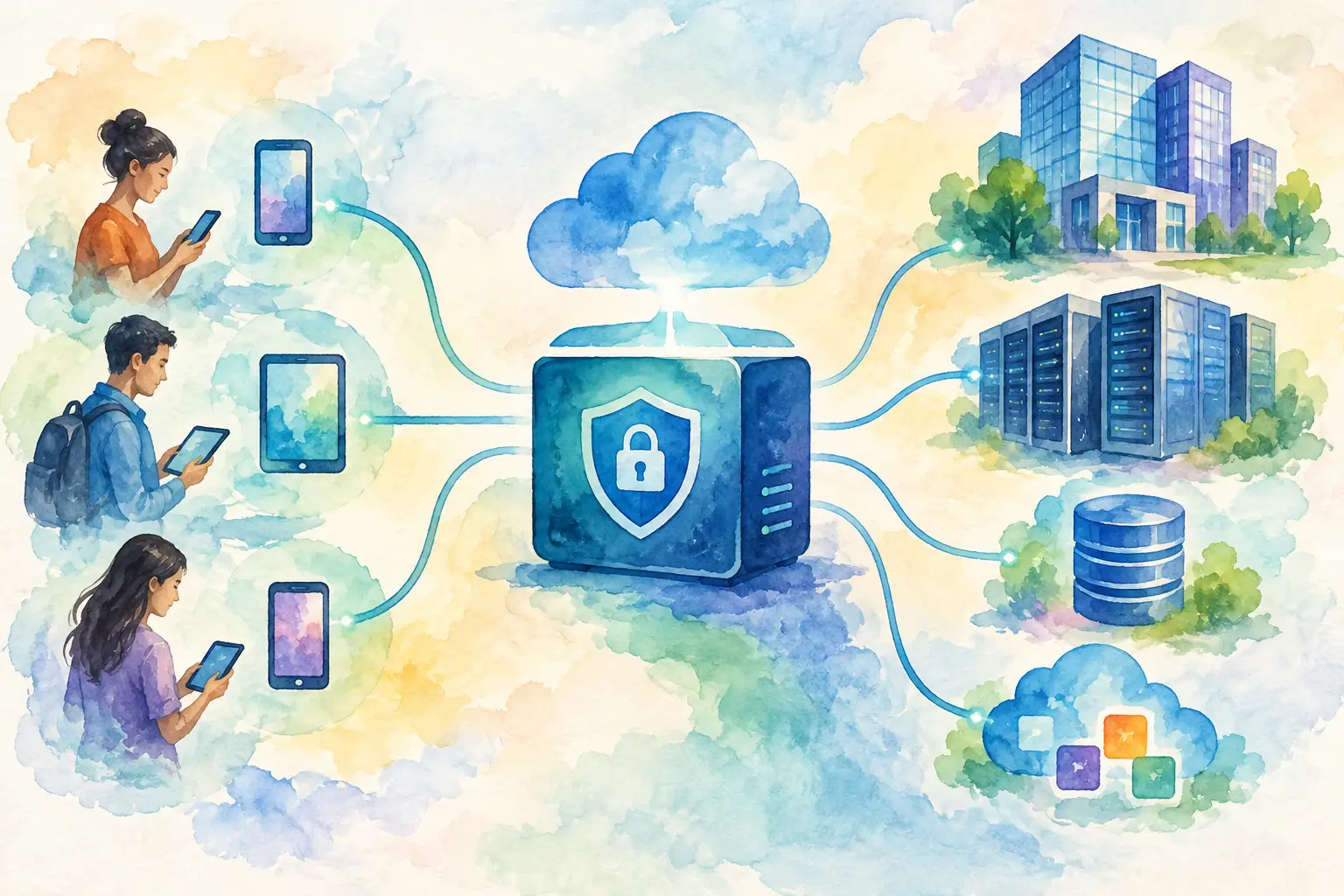
A mobile gateway fleet rarely fails because a single phone stops registering. It fails when operations cannot see which device, SIM, route, carrier condition, or SIP policy caused the degradation. Enterprise mobile gateway architecture is therefore not a question of connecting phones to SIP. It is the operating model that keeps distributed mobile connectivity measurable, controllable, and supportable as the fleet grows.
For telecom operators, VoIP providers, and systems integrators, the architecture must account for two very different realities at once: mobile devices are physical endpoints with batteries, radio conditions, and local dependencies, while SIP infrastructure expects predictable registration, routing, call state, and records. The design must expose both sides in one operational view.
Enterprise Mobile Gateway Architecture Has Three Planes
A workable design separates the endpoint plane, media and signaling plane, and control plane. These planes interact continuously, but they should not be treated as the same system. That separation makes troubleshooting faster and prevents a local device event from becoming an untraceable routing problem.
The endpoint plane contains the phones, SIMs, connection hardware, and local network conditions. Its job is to make authorized mobile connectivity available and report its real state. A device can be online yet unsuitable for calls because of weak signal, an unavailable SIM, an audio-path issue, or an application-level registration failure. Endpoint status needs more depth than a green availability indicator.
The media and signaling plane connects the mobile side to the organization’s telephony environment. This is where SIP trunks, call routing, codecs, registration behavior, concurrency limits, and failure responses are managed. It must fit established systems such as Asterisk, FreePBX, 3CX, Kamailio, OpenSIPS, SBCs, and WebRTC workflows without forcing the operator to rebuild existing dial plans.
The control plane is where enterprise operations become possible. It centralizes provisioning, device assignment, route policy, profiles, alerts, CDRs, reporting, balances, and user actions. Without it, a larger deployment becomes a collection of remote handsets maintained through manual checks and disconnected spreadsheets.
Endpoint plane: treat phones as managed gateway assets
A phone used as a gateway endpoint should have an identity, location, connection method, assigned SIM context, current availability, and recent call history. The NOC should be able to determine whether an issue is isolated to one handset, one site, one carrier group, or one route.
Connection architecture matters here. USB connectivity can suit installations that prioritize wired density and direct physical organization. Bluetooth-based wireless connectivity can reduce cable dependency where device placement is constrained. A dedicated bridge approach can be appropriate when cable-free digital wideband audio is required. None is universally best. The correct choice depends on rack layout, expected call volume, audio requirements, local power design, and the ability of site staff to service devices.
Device monitoring should include practical fields: registration state, signal condition, active calls, last activity, battery or power condition where available, assigned profile, and failure reason. A generic offline alert creates work. A specific status label gives an engineer a starting point.
SIP and media plane: make route behavior explicit
Mobile endpoints should not sit outside the normal routing discipline of the voice network. Define how calls arrive, which trunk or profile is permitted to use each gateway group, what happens on a failed attempt, and when a route is removed from service. These decisions should be visible in the same environment used to inspect calls and CDRs.
Codec and audio-path choices require particular care. Wideband audio can improve the call experience where the endpoint, connection method, and downstream SIP path support it. But a mixed fleet may need conservative codec policy to avoid transcoding overhead or inconsistent call quality. Test the full media chain rather than validating audio only at the handset.
Registration behavior also needs boundaries. Frequent re-registration may indicate network instability, application interruption, or an upstream configuration issue. A well-designed architecture records the event and correlates it with the affected device and trunk, rather than presenting it as a standalone SIP error.
Control plane: centralize decisions, not just dashboards
Central management is useful only when it changes the operating workflow. A device table is valuable when an administrator can identify an unavailable gateway, inspect its assigned SIM and location, review recent calls, and apply the appropriate operational action without changing tools.
The same principle applies to routing and customer operations. Route statistics should show traffic volume and quality indicators such as ASR and ACD in context. CDRs should support investigation of call outcomes, duration, timestamps, route selection, and account activity. Prepaid balances and customer profiles should connect directly to call control and billing decisions, not exist as a separate finance record.
GSMCalls is designed around this control-plane model, bringing device operations, SIP configuration, call activity, reporting, and billing workflows into a single cloud-managed workspace. The objective is not to hide infrastructure. It is to make the infrastructure legible across a distributed fleet.
Design for Failure Domains, Not Ideal Conditions
A gateway fleet spanning multiple cities or countries has several failure domains: individual devices, local internet access, site power, carrier coverage, SIP trunk reachability, and control-plane access. Architecture should limit the operational impact of each one.
Group devices by meaningful boundaries such as site, carrier, customer profile, or route purpose. This enables an operator to remove a degraded group from routing without affecting unrelated capacity. Avoid placing all capacity for a critical route behind a single local network or physical location simply because it is convenient during deployment.
Alerting should be selective. Notify on events that require action: a gateway group becomes unavailable, registration failures exceed an expected threshold, a balance reaches a defined limit, or route quality declines beyond a policy threshold. If every transient state becomes an alert, the team learns to ignore the alert channel.
Capacity planning should use observed demand, call duration, concurrent-call patterns, and route quality rather than device count alone. Ten available phones do not necessarily provide ten useful call paths. Signal conditions, connection mode, codec choices, account policy, and current call state all affect usable capacity.
Build Observability Into Every Call Path
The most useful operational question is simple: why did this call take this route and what happened next? Answering it requires correlation across the call record, gateway, device, SIM assignment, trunk, and customer or profile context.
At minimum, operations teams need live call visibility alongside historical CDRs. Live views support incident response. Historical records support quality analysis, billing reconciliation, dispute handling, and route tuning. ASR and ACD are useful indicators, but they are not final diagnoses. A falling ASR may point to destination conditions, an unavailable gateway group, incorrect dialing policy, or a trunk configuration change. Architecture should preserve enough context to distinguish among them.
This is also where honest status is more valuable than cosmetic availability. A device marked available while its route is administratively disabled can mislead the team. Clear state labels reduce handoffs between NOC, VoIP administration, and customer operations.
Security and Change Control Are Operational Requirements
Enterprise deployments need role-aware access, controlled provisioning, and a clear record of configuration changes. The team responsible for routes may not be the team responsible for balances or device deployment. Separating responsibilities reduces accidental changes while preserving the shared operational picture.
Use documented naming conventions for locations, gateway groups, trunks, and profiles from the first deployment. Consistent names make reporting useful months later, when a call issue must be traced across a larger fleet. Apply configuration changes in a limited scope first, verify registration and test calls, then expand deliberately.
For authorized deployments, carrier agreements, local telecom requirements, and internal usage policy belong in the architecture discussion as well. A technically functional route is not automatically an approved route. Operational controls should reflect the organization’s legal and commercial obligations.
Start With the Troubleshooting Workflow
The best architecture is one that lets an engineer move from an alert to a verified cause with minimal guesswork. Before adding capacity, define what the team will check when a call fails, audio quality drops, a phone loses connectivity, or a route’s ASR changes. Then make sure the device, SIP, and billing data needed for that investigation is visible in the same operating workflow.
That discipline turns a collection of mobile devices into managed telecom infrastructure: not because every component is perfect, but because the team can see the actual condition, isolate the affected domain, and make a controlled decision before a local issue becomes a fleet-wide incident.