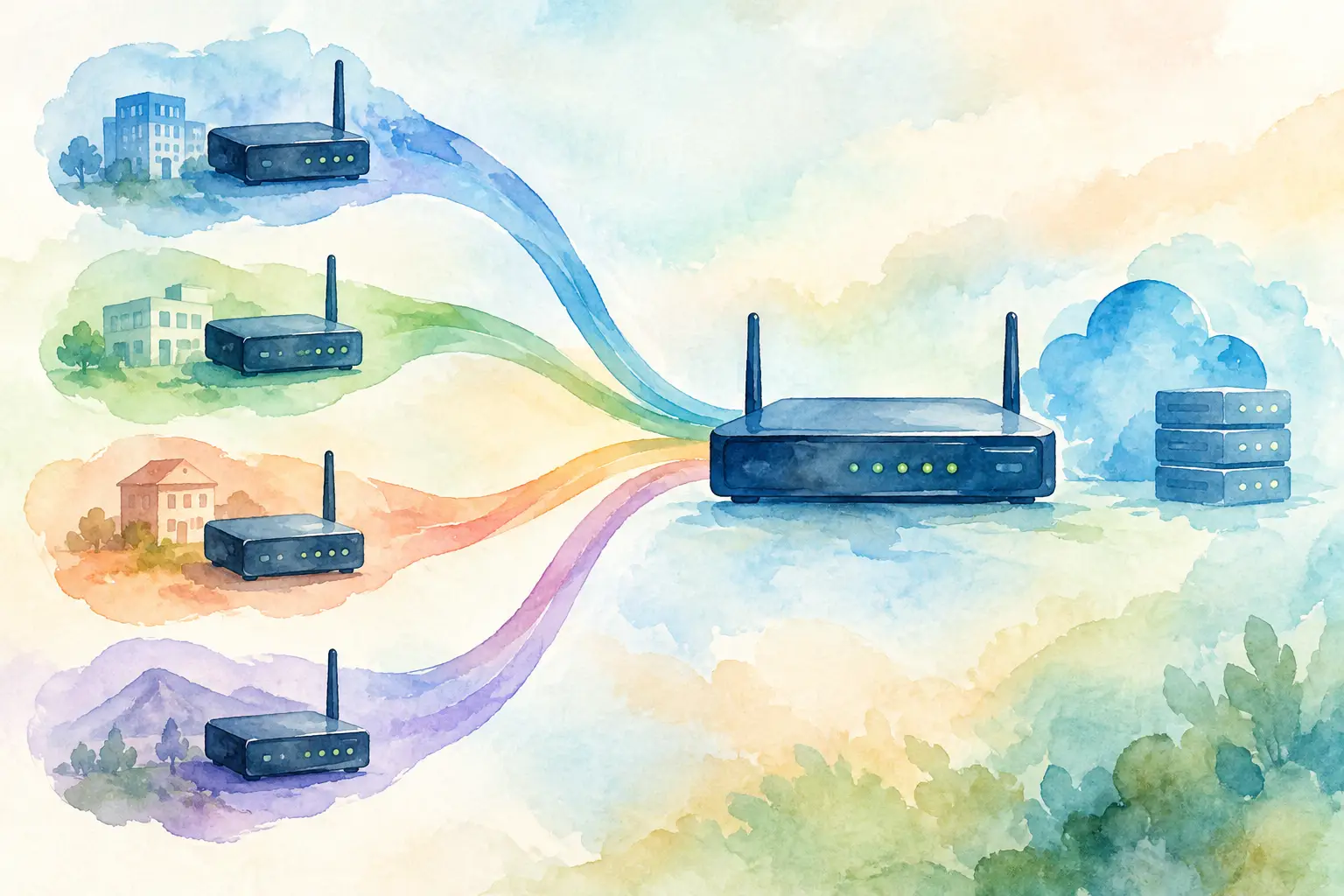
A gateway consolidation example becomes useful when an operations team has outgrown the spreadsheet-and-login model. Devices sit in several locations, SIP trunks are configured in more than one system, and NOC staff must ask basic questions manually: Is the handset registered? Which SIM is in use? Why did ASR drop on this route? Which calls failed, and where?
Consolidation does not mean putting every physical device in one rack. For distributed SIP operations, it means bringing device state, call control, routing, reporting, and financial controls into one operating model while preserving the local connectivity each site requires. The result is less context switching and a clearer path from an alert to the underlying call record, device, route, or carrier condition.
The Starting Point: A Fragmented Gateway Estate
Consider a lawful, authorized voice provider operating 80 mobile-connected SIP endpoints across four regional offices. Each office has its own local technician, internet connection, mobile devices, and carrier relationships. Calls are delivered to a central SIP environment, but the supporting workflow is fragmented.
The technical team uses one interface for PBX routing, another for device status, a shared file for SIM inventory, and separate exports for CDR review. When a customer reports intermittent failures, the team can see a failed SIP attempt but may not immediately know whether the cause is device availability, signal degradation, registration loss, an exhausted prepaid balance, or a routing rule.
This model may work at 10 devices. At 80 devices, its real cost is operational delay. A device can remain unavailable longer than necessary because the person who sees the SIP symptom cannot see the mobile endpoint state. Reporting also becomes slow because CDRs, balances, and route metrics are not connected in the same workflow.
Gateway Consolidation Example: One Control Plane, Local Endpoints
In the consolidated design, the provider keeps mobile endpoints in their existing regional locations. What changes is how those endpoints are provisioned, observed, and connected to the SIP environment.
Each device is enrolled in a cloud-managed gateway platform and assigned to a defined location, device profile, and routing context. The operations team can use USB Connect where wired density is appropriate, Wireless Connect where Bluetooth connectivity suits the site, or a Smart Bridge where cable-free digital wideband audio is preferred. The connection method is a deployment decision, not a separate operational system.
The platform becomes the working control plane for the fleet. From one workspace, authorized users can inspect device availability, signal state, active calls, SIP registration, SIM-related records, trunks, routes, balances, alerts, and CDRs. The existing Asterisk, FreePBX, 3CX, Kamailio, OpenSIPS, SBC, or other SIP environment remains part of the call path. Consolidation is not necessarily a rip-and-replace project.
For this provider, the core layout might look like this:
- Regional endpoint groups remain local to protect site-level carrier and connectivity requirements.
- SIP trunks are defined centrally and mapped to approved routes and device groups.
- Customer profiles and prepaid billing rules are managed alongside call records and balances.
- NOC users monitor live status and exception conditions from a single dashboard.
The important distinction is that central visibility does not erase local accountability. A regional technician can still replace a handset or check a local power issue. The central team gains the evidence needed to direct that work quickly.
Device provisioning moves from ad hoc to repeatable
Before consolidation, adding a device may involve manual naming, local SIP credentials, a spreadsheet update, and a separate test call. The process is hard to audit, and configuration drift is common.
In the consolidated workflow, an engineer assigns the device to its location and profile, associates it with the required trunk or route policy, confirms registration, and validates a controlled test call. The same device record remains the reference point for ongoing health, calls, and configuration. If a replacement handset is needed, the team can preserve the operational identity and document the change rather than rebuilding the context from scratch.
Routing decisions gain operational context
Routing should not be evaluated only by whether a trunk accepted an INVITE. A route that technically completes calls but produces declining ASR, short ACD, repeated failures, or elevated latency needs investigation.
With consolidated records, a NOC engineer can move from a route-level KPI to recent CDRs, then to the relevant gateway and device state. If calls from one location show a higher failure pattern, the team can compare signal, registration behavior, trunk status, and time windows before changing the route. That reduces the risk of making a broad routing change to solve a local problem.
How the Team Handles a Live Incident
Assume the provider receives an alert that calls through the Chicago device group are failing above the team’s normal threshold. In the fragmented model, the NOC engineer might first check the PBX, contact the local office, request screenshots, and wait for a device inventory confirmation.
In the consolidated model, the first check is the group status. Are all devices affected or only a subset? Are SIP registrations active? Is one trunk unavailable? Are calls reaching the devices but failing later in the call flow? CDR filters can narrow the incident to a time range, destination pattern, customer profile, or route.
Suppose the dashboard shows that two devices are offline while the remaining devices are healthy. The evidence points toward a local power, handset, or connectivity issue rather than a global route failure. The NOC can keep healthy capacity in service, notify the site contact with specific device identifiers, and avoid needlessly rerouting all Chicago traffic.
Now consider the opposite case: devices are online, signal is normal, and registrations are current, but a specific SIP trunk is rejecting attempts. The incident belongs in the SIP interconnection workflow. Centralized visibility does not eliminate diagnosis. It makes the handoff accurate.
Billing and CDRs Belong in the Same Operational View
Gateway operations and billing are often treated as separate domains until a customer balance or usage rule affects call service. That separation creates avoidable escalations.
A consolidated design puts customer profiles, prepaid balances, usage records, and detailed CDRs close to the routing and device data that teams already use. Support staff can determine whether a failed or blocked attempt corresponds to an account condition, while finance or operations can reconcile call activity without collecting exports from multiple systems.
This does not mean every organization needs the same billing workflow. A wholesale provider may prioritize customer-level balances and route profitability review. An enterprise may care more about departmental allocation and call traceability. The design should reflect the commercial model, but the underlying principle holds: the record of a call should not be detached from the controls that governed it.
What Consolidation Does Not Solve Automatically
A central platform improves control, but it does not remove physical and network realities. A device still depends on power, local internet, hardware condition, and approved carrier service. A location with poor radio conditions will not become reliable because its dashboard is better.
There are also architecture trade-offs. USB-based deployments can provide efficient wired density, but they require planned cabling and host management. Wireless connectivity can simplify placement but should be assessed for local radio conditions and operational scale. A Smart Bridge can reduce cable dependency and support digital wideband audio, yet it should still be deployed with clear monitoring, spares planning, and site documentation.
Consolidation also requires disciplined access control and operational ownership. If everyone can alter routes or device profiles without change review, a single control plane can centralize risk as easily as it centralizes visibility. Define who can provision devices, modify routing, review CDRs, and manage customer balances.
A Practical Rollout Sequence
The safest approach is usually staged. Start by documenting the current fleet: locations, device identifiers, connection method, SIM records, SIP trunks, routes, and known service dependencies. Then enroll a limited device group and compare its call behavior, registration stability, ASR, ACD, and incident response time against the existing workflow.
After the pilot proves the monitoring and routing model, migrate site by site. Keep rollback conditions explicit. For each site, verify device status, test inbound and outbound authorized call paths, confirm CDR capture, validate alerts, and ensure local contacts know what information the NOC will request during an incident.
GSMCalls is designed around this operational model: mobile devices remain flexible local endpoints while gateway control, SIP configuration, telemetry, call records, and billing workflows are managed centrally.
The useful outcome is not consolidation for its own sake. It is the ability to answer an operational question with evidence while the call, route, device, and customer context are still visible in the same place.