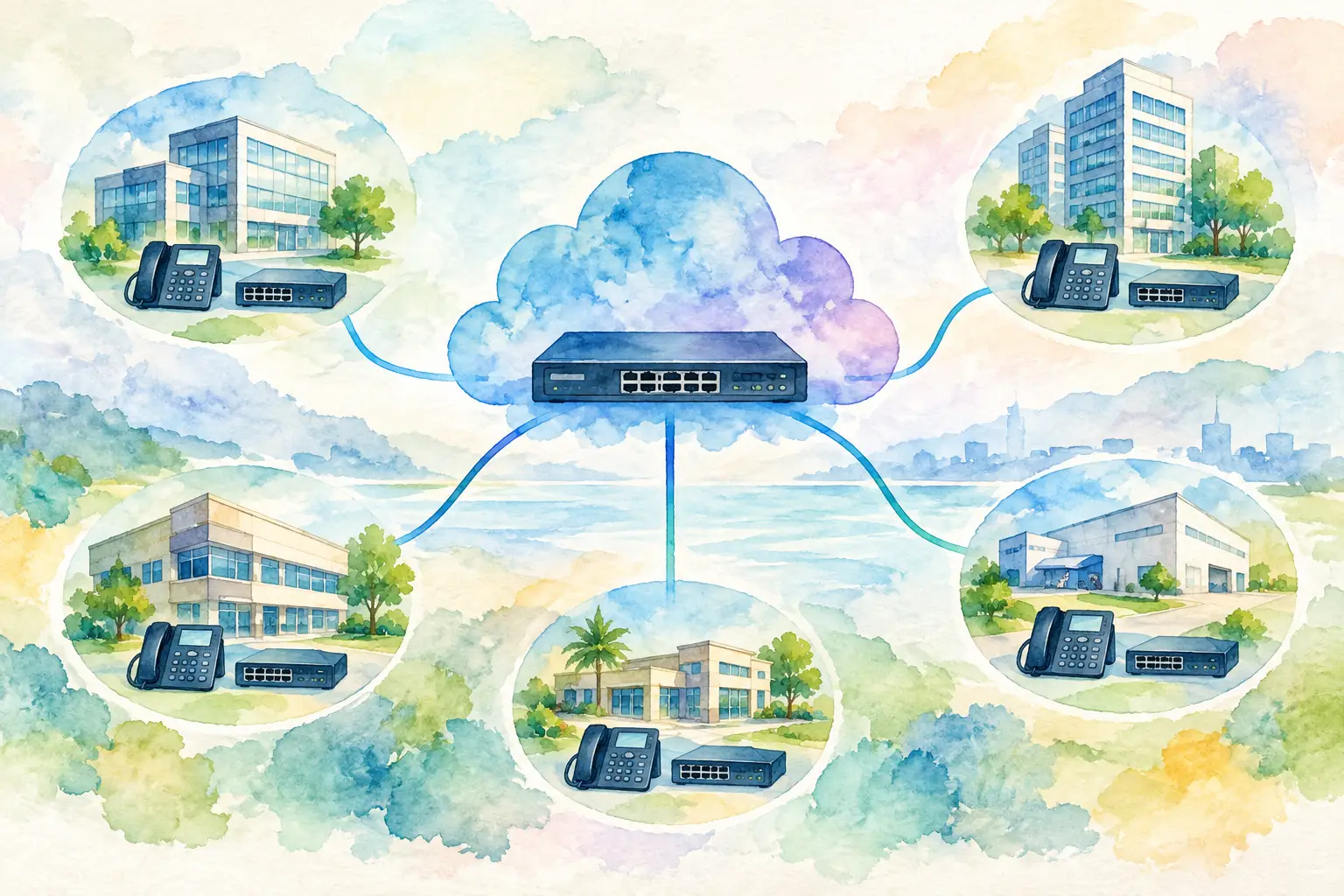
A gateway fleet usually fails at the edges, not in the SIP core. One location loses stable mobile coverage, a handset disconnects, a local internet circuit adds latency, or a route continues sending traffic to devices that are no longer available. A workable multisite phone gateway design treats every site as an observable service edge while giving operations one place to control routing, devices, calls, and records.
For VoIP providers, operators, and enterprises with distributed mobile connectivity, the objective is not simply to place phones in multiple offices. The objective is to create predictable call handling across locations without turning each site into its own manual support problem.
Start With Failure Domains, Not Device Count
The first design decision is the operational boundary of each location. A site should be able to experience a local issue without creating uncertainty across the entire fleet. That means defining which devices, SIMs, internet connection, SIP registration, power source, and escalation path belong to that location.
A small branch with two active phones has different needs from a regional site with dozens of devices. The smaller site may prioritize simple recovery procedures and a backup internet connection. A higher-density site needs clearer device grouping, capacity thresholds, power planning, and more deliberate route distribution. Treating both as identical creates blind spots.
Each location should have a defined identity in the management platform. Device names, SIM references, trunks, route labels, and customer or service profiles need to make the site obvious during an incident. If a NOC engineer sees a failed call or a registration event, they should not have to infer which city, rack, or operational group owns it.
Separate Local Connectivity From Central Policy
Centralized management does not require every decision to be centralized at the physical layer. The phone connects locally, has its own radio conditions, and may depend on local power and broadband. Routing policy, monitoring, CDR retention, customer settings, balances, and reporting can remain centralized.
This separation matters when a single site degrades. A central control plane can stop assigning new traffic to an unhealthy location while keeping the rest of the fleet active. It also gives the operations team a consistent way to compare signal quality, registration state, call attempts, failures, and device availability across sites.
Build the SIP Layer Around Explicit Routing Rules
A multisite gateway environment needs deterministic SIP routing. Avoid route logic based on informal naming conventions or assumptions that an operator will remember which devices are available in each city. Define the relationship among SIP trunks, dial plans, gateway groups, locations, and fallback behavior before adding production traffic.
For each route, document the expected destination pattern, preferred gateway group, codec policy, concurrent-call limits, and the response when capacity is unavailable. In many environments, this is handled by Asterisk, FreePBX, 3CX, Kamailio, OpenSIPS, or an SBC. The gateway platform should complement that existing SIP architecture rather than create a parallel routing model nobody can troubleshoot.
Number normalization deserves special attention. Normalize called numbers at the edge of the dial plan, then log the normalized form consistently in call records. A route that receives mixed formats can look healthy while silently producing avoidable failures. The same applies to SIP response mapping: distinguish rejected calls, unavailable devices, registration failures, carrier-side failures, and upstream trunk errors whenever the signaling makes that distinction available.
Use Fallback Carefully
Fallback is useful, but it is not a substitute for capacity planning. A route can fail over from one gateway group to another when a site is unavailable, yet that fallback group must have verified spare capacity. Otherwise, an isolated problem becomes a fleet-wide ASR and ACD problem.
Set a clear threshold for when traffic should leave a location. It may be based on active device count, repeated call failures, loss of registration, degraded signal indicators, or a local connectivity alert. The right threshold depends on traffic volume and service commitments. What matters is that the condition is measurable and that the route behavior is intentional.
Choose a Connection Method for the Site, Not the Marketing Sheet
Physical deployment choices affect density, recovery time, audio behavior, and cable management. USB-connected phones can suit controlled, high-density installations where wired connections and charging are straightforward to maintain. Wireless Bluetooth connectivity can reduce cabling in lower-density or flexible deployments, but it requires disciplined pairing and local radio planning.
A digital connection method such as GSMCalls Smart Bridge can be appropriate where cable-free deployment and wideband HD audio are operational priorities. The design question is not which method is universally best. It is whether the connection method fits the site’s physical constraints, required scale, expected maintenance process, and audio requirements.
Standardize where practical. A fleet with three connection models at every site may be flexible, but it also makes spare inventory, technician training, and incident diagnosis harder. Use exceptions only when there is a documented reason, such as a location with limited rack space, a temporary deployment, or a need for a specific audio path.
Make Device Health a Routing Input
A device marked online is not necessarily ready to take calls. An operational design should account for phone connectivity, gateway connection state, SIP registration, signal condition, battery or charging state where applicable, active calls, and recent call outcomes.
This is where centralized monitoring changes the day-to-day workload. Rather than checking individual handsets, the operations team should be able to identify locations with declining availability, devices that repeatedly disconnect, trunks with registration issues, and routes showing abnormal failure patterns. A device table is useful only if it helps answer an immediate question: can this endpoint take the next call, and if not, why not?
Alerts should be specific enough to support action. “Gateway offline” is useful, but an alert that includes the device, location, last known state, associated route, and duration is much easier to triage. Avoid alerting on every transient event. Alert fatigue causes teams to ignore the same monitoring system that should protect service quality.
Design CDRs and Billing Into the Operating Model
In a multisite environment, CDRs are not just billing artifacts. They are the evidence trail for route analysis, service disputes, capacity planning, and incident review. Records should let the team correlate call time, duration, route, device or gateway, location, SIP outcome, and relevant customer or profile context.
If the business uses prepaid balances or customer profiles, define where authorization occurs and what happens when a balance reaches its limit during traffic peaks. The system should make that state visible before it becomes a support issue. Operations, finance, and account management may use different views of the same data, but they need consistent call records underneath.
Review ASR, ACD, failed-call causes, and device availability by location as well as by route. Fleet-level averages can hide a single site that is consuming support time or producing poor call outcomes. Conversely, one bad hour at one site should not be mistaken for a systemic routing issue without checking the local telemetry.
Plan for Local Recovery Without Local Guesswork
Every location needs a short, repeatable recovery procedure. It should cover power, phone connectivity, internet access, SIP registration, device state, and escalation. A technician should know whether to reconnect a phone, verify a local network condition, replace a device, or hand the issue to the SIP team.
Keep spares aligned with the actual deployment design. If a site depends on a particular phone model, bridge, cable type, or power arrangement, a generic spare may not restore service quickly. Record the physical setup well enough that a remote engineer can guide an on-site contact without relying on tribal knowledge.
Security and access control also belong in the recovery plan. Limit administrative access, use controlled credentials for SIP infrastructure, and keep device ownership clear. Deployments should be authorized and operated in accordance with applicable carrier, telecom, and local requirements.
Roll Out in Measurable Stages
Do not begin with a full fleet migration. Start with one representative location and validate device onboarding, SIP registration, inbound and outbound call paths, codec handling, DTMF behavior, CDR accuracy, alerts, and recovery procedures. Then add a second site with different network or density conditions to test whether the model actually transfers.
Once the design is proven, use templates for naming, routing groups, device profiles, monitoring thresholds, and incident notes. Templates reduce configuration drift, but they should not hide legitimate local differences. A site with unstable broadband or lower signal quality may require tighter thresholds and more conservative call limits.
The useful test of a multisite gateway design is not whether every device appears in one dashboard. It is whether an engineer can identify a failing location, understand the failure cause, protect other routes, and restore the site without improvising. That is the point where distributed phones become managed telecom infrastructure rather than a collection of remote endpoints.