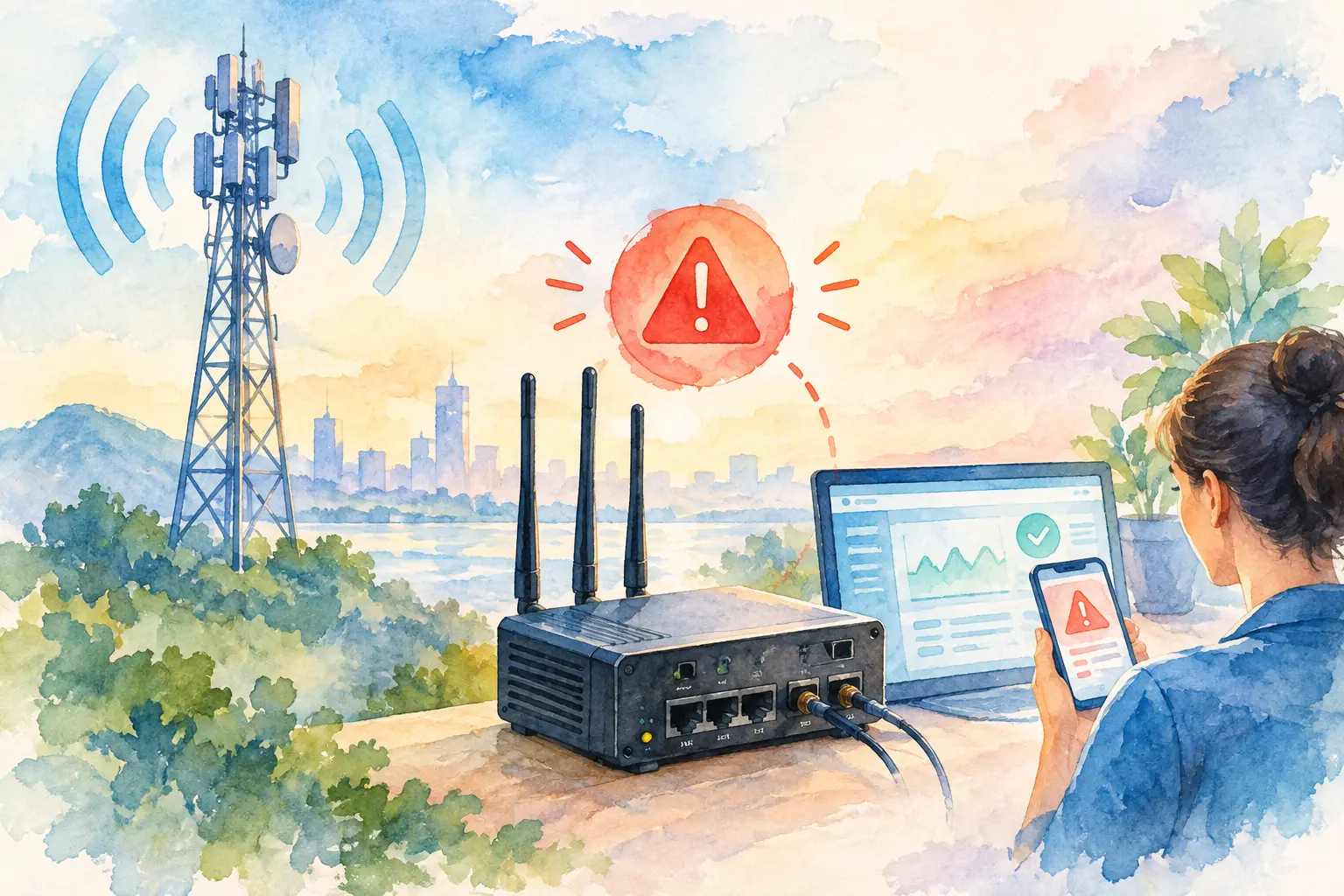
A gateway can appear online while revenue-impacting calls are already failing. A phone may retain power and network registration but lose its audio path, fail SIP re-registration, exhaust a prepaid balance, or receive calls that never reach the expected route. GSM gateway failure alerts turn those hidden conditions into actionable operational signals before a route issue becomes a customer escalation.
For telecom teams running distributed mobile gateway fleets, the objective is not simply to know whether a device is connected. It is to know whether the device can accept, place, and complete authorized calls at an acceptable quality level. Effective alerting connects device telemetry with SIP state, carrier conditions, active call behavior, and CDR outcomes.
What GSM Gateway Failure Alerts Should Detect
A useful alert model starts with failure domains. If every event is labeled only as "gateway offline," engineers lose the context needed to respond quickly. The same visible outage can originate in handset power, USB connectivity, Bluetooth pairing, Smart Bridge communication, local internet access, SIP registration, a SIM condition, or a routing rule.
Device availability is the base layer. A gateway that has stopped reporting to the management plane needs attention, but the alert should identify its last-seen time, assigned location, connection method, associated mobile device, and current operational profile. This makes it possible to distinguish a short reporting interruption from a device that requires physical intervention.
SIP failures require their own alerts because a reachable device is not necessarily available to the PBX, SBC, or softswitch. Monitor registration state, registration age, authentication failures, trunk reachability, and repeated re-registration attempts. A single failed registration during a network transition may be transient. Repeated failures across multiple gateways using the same trunk point more strongly to a credential, DNS, firewall, or upstream SIP issue.
Carrier and SIM conditions need equal visibility. Weak or absent signal, loss of network registration, unavailable service, balance-related call failures, and unusual call rejection patterns should be surfaced at the gateway and route level. A NOC team should be able to see whether a problem is isolated to one SIM or shared by a carrier group, city, or device profile.
The last layer is call performance. Low ASR, falling ACD, rising setup failures, short-call patterns, or a sudden increase in disconnect causes may indicate a route problem even when every component remains technically online. CDRs are essential here. They provide the evidence behind an alert and prevent operations from treating every alarm as a device fault.
Alert on Service Impact, Not Just State Changes
The most common alerting mistake is treating every state change as equally urgent. A gateway briefly reconnecting after a local Wi-Fi change is not the same event as a route losing capacity during peak traffic. The alert priority should reflect call impact, redundancy, and duration.
A practical policy uses three operational levels. Critical alerts are for events that immediately remove service or materially reduce route capacity, such as a gateway group becoming unavailable, a SIP trunk losing registration across several devices, or a cluster-wide communications failure. High-priority alerts cover degraded conditions that need prompt investigation, including persistent low signal, repeated call setup errors, or a gateway that has been offline beyond its defined recovery window. Warning alerts identify conditions that deserve review but do not require an immediate wake-up call, such as intermittent reconnects or a gradual decline in answer rate.
Thresholds should be evaluated in context. A signal-strength alert may be useful when it persists for 10 minutes and coincides with failed calls. It is less useful when it fires for a brief radio fluctuation that has no CDR impact. Likewise, an ASR alert should be based on a meaningful call sample. A route with three attempts should not trigger the same response as a route with hundreds of attempts and a sustained decline.
This is where aggregation matters. One failed call is an event. Twenty failed calls from gateways assigned to the same carrier, location, or SIP route is an incident pattern.
Build Alerts Around the Operator Workflow
An alert is only valuable if the recipient can make a decision from it. A message that says "device error" creates another investigation step. A message that identifies the gateway, location, connection state, SIM status, SIP registration state, recent call failure trend, and affected route gives the NOC a starting point.
Each alert should answer four questions: what failed, when it began, what traffic or capacity is affected, and what evidence supports the condition. Include stable identifiers that match the operations workspace, such as gateway name, device ID, trunk, route, carrier group, and location. If an engineer needs to search manually for basic context, mean time to resolution increases.
The response path should also be explicit. For example, a gateway offline alert may first require a check of handset power, local network connectivity, and the selected connection method. A SIP registration alert should direct attention toward trunk credentials, reachability, and PBX or SBC logs. A low-ASR alert should begin with CDR review: identify disconnect causes, compare the affected route against alternatives, and confirm whether the issue is limited to a carrier or location.
GSMCalls supports this workflow by placing gateways, devices, active calls, SIP routing, alerts, and CDR reporting in a single operational view. That matters when the first question is not "did an alert occur?" but "what changed around this route when the alert began?"
Correlate the control plane with live traffic
A dashboard status label should never be the final diagnosis. Use the control plane to verify the gateway's reported state, then compare it with active calls and recent CDRs. If the device is online and SIP registered but call setup failures are climbing, the next action is route and carrier analysis rather than a device restart.
Conversely, if several gateways show disconnects at the same time while their SIP trunks remain healthy, investigate shared physical dependencies. They may share a site network, power source, wireless environment, or bridge configuration. Correlation prevents teams from opening separate tickets for symptoms of the same fault.
Reduce Noise Without Hiding Real Failures
Alert fatigue is not solved by increasing thresholds until the dashboard becomes quiet. It is solved by suppression rules, dependency awareness, and recovery confirmation.
Use a short delay before opening alerts for events that commonly self-correct, such as a brief device reconnect. Then escalate when the condition persists or repeats within a defined period. Pair failure alerts with recovery notifications so operators can see whether the service returned without needing to recheck every gateway manually.
Maintenance windows also need disciplined handling. Planned device moves, profile changes, handset updates, and site work can create expected alarms. Suppress alerts only for the affected gateway group and only for the approved period. Broad suppression rules are risky because they can conceal an unrelated route failure.
Avoid sending identical alerts from every layer. If a site connectivity issue takes down 30 devices, the primary incident alert should identify the shared dependency and affected capacity. Device-level details should remain available for investigation, but they should not create 30 separate pages for the same outage.
Measure Whether Alerts Improve Operations
Alerting should be reviewed like any other routing control. Track how often alerts lead to confirmed incidents, how long conditions persist before detection, and how quickly teams restore service. Compare alert timestamps with CDR changes to confirm whether the rule catches degradation early enough to protect traffic.
False positives deserve analysis, but so do missed incidents. If a route's ASR declines for an hour before any alert appears, the threshold may be too loose, the evaluation window may be too long, or the signal being monitored may be too narrow. If an alert fires regularly with no measurable impact, it should be refined rather than accepted as background noise.
The best GSM gateway failure alerts are operational instruments, not decorative dashboard badges. They tell the right team which service condition changed, how much traffic it affects, and where to begin. When alerts are tied to live device state, SIP health, carrier context, and CDR evidence, operators can spend less time proving that a fault exists and more time restoring the route that matters.