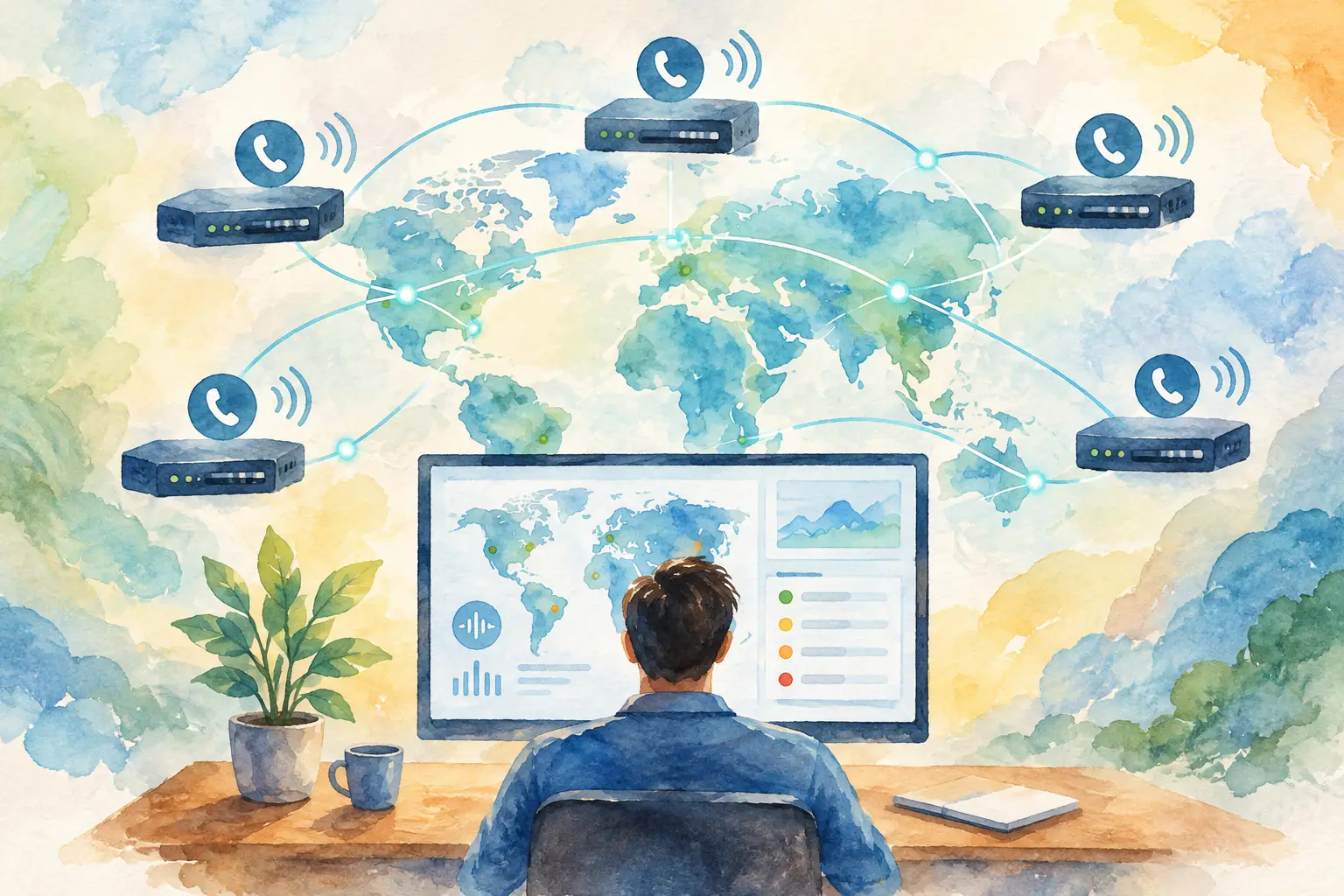
A gateway can appear online while the traffic behind it is already failing. The handset may be reachable, but its mobile signal has dropped. A SIP registration may still exist, but calls are receiving one-way audio or ending early. A route can be accepting calls while ASR and ACD quietly decline. To monitor distributed voice gateways effectively, operations teams need to see the complete service path, not just a green device status.
For fleets spread across offices, racks, cities, or countries, that visibility has to be centralized. Engineers should be able to move from a route-level quality issue to the affected gateway, device, SIM, carrier state, and individual CDRs without collecting screenshots or asking local staff to inspect hardware.
Monitor Distributed Voice Gateways as a Service Chain
A distributed gateway is not one component. It is a chain that includes a mobile device, a physical or wireless connection method, audio transport, gateway software, SIP registration, routing rules, carrier connectivity, and the downstream customer or trunk relationship.
Monitoring only one layer creates false confidence. For example, a device can be powered and connected to the cloud while its assigned SIM has no usable service. Conversely, a gateway can have excellent signal strength but fail to deliver calls because a SIP trunk is unreachable or a route profile is misconfigured.
A useful monitoring model separates this chain into three operational views: availability, quality, and commercial impact. Availability answers whether the endpoint can accept work. Quality shows whether calls complete and remain stable. Commercial impact shows which routes, customers, balances, or traffic patterns are affected when either of the first two conditions changes.
This distinction matters during incident response. An offline device is a clear availability event. A gradual ACD decline across online devices is a quality investigation. A prepaid balance condition preventing a customer profile from placing calls is a commercial control event. These cases require different owners and different actions.
Start With Device and Connection Health
At the gateway layer, NOC teams need a live inventory that identifies each endpoint by location, profile, assigned route, device state, and connection method. A large fleet cannot be managed from a generic list of phone names. The table should make it obvious which devices are active, unavailable, idle, in a call, or waiting for operator attention.
Connection health needs context. A wired USB deployment may require attention to host connectivity, port availability, and device recognition. A Bluetooth deployment introduces pairing state and wireless stability. A Smart Bridge deployment shifts the focus toward bridge availability and the digital audio path. The dashboard should represent these as operational states, not as a collection of unrelated technical logs.
Battery and charging state also belong in the device view. Mobile phones are endpoints, and endpoint power is part of service continuity. A device that repeatedly disconnects under load may point to charging capacity, thermal behavior, local connectivity, or an unstable physical connection. The monitoring system should preserve enough event history to distinguish a single interruption from a repeating condition.
Location labels are equally practical. When an alert identifies a gateway, the operator should immediately know whether it is in a data center rack, a branch office, a managed site, or a remote installation. Clear location and ownership fields reduce time spent finding the person who can perform hands-on work when remote recovery is not possible.
Use Signal Data as an Operational Indicator
Signal strength should be monitored continuously, but it should not be treated as the only mobile quality measurement. Strong signal does not guarantee successful call setup, stable media, or acceptable call duration. Still, declining signal values across several devices at one location can identify a local coverage or site condition before it becomes a larger traffic issue.
Set thresholds from observed performance rather than applying one universal number to every location. Carrier conditions, device placement, building materials, and regional radio environments differ. The useful alert is not simply low signal. It is a meaningful deviation paired with failed calls, registration instability, or a reduction in available channels.
Correlate SIP State With Call Outcomes
SIP registration status is necessary, but it is not the same as call readiness. A registered endpoint may fail on INVITE handling, media setup, codec negotiation, or route selection. Monitoring should show the registration state alongside trunk status, active calls, recent failure causes, and last successful call activity.
For SIP trunks and routes, watch registration age, re-registration events, response codes, routing selection, and concurrent call utilization. A sharp increase in 4xx, 5xx, or timeout responses can expose an issue earlier than a complete service outage. The goal is not to alert on every protocol response. It is to identify patterns that depart from the normal behavior of that route.
CDRs provide the evidence required to validate those patterns. Engineers should be able to filter records by gateway, SIM, route, customer profile, date range, destination class, call result, and duration. When a route shows lower ASR, the next question is whether failures are concentrated on one gateway, one mobile operator, one time window, or one call type.
ACD deserves the same treatment. A low ACD value may indicate callers are disconnecting, media is unstable, destination behavior has changed, or a specific route is unsuitable for current traffic. The metric alone does not diagnose the problem. Its value comes from correlation with detailed call records, gateway events, and SIP outcomes.
Monitor SIMs and Carrier Exposure Separately
SIM administration should not be buried inside device status. One device may have a healthy operating system and connection while the SIM assigned to it has a service issue, balance concern, or unexpected usage pattern. A dedicated SIM view helps teams understand which mobile resources are active, assigned, inactive, or generating exceptions.
For authorized deployments, track SIM-to-device assignment, operator identity, current service status, usage history, and relevant balance information. This prevents a common operational gap: a technician replaces or moves a phone, but the inventory and routing context are not updated. The result is confusion during the next incident because physical reality and the control plane no longer match.
Carrier patterns should be monitored at the group level as well as per SIM. If multiple SIMs from the same operator and location show reduced availability or failing calls, the incident may be external to the gateway fleet. If only one device shows the problem, the investigation should remain local until evidence suggests otherwise.
Build Alerts Around Actionable Conditions
Alert fatigue is usually a design problem. A NOC does not need a notification for every state transition. It needs alerts that identify a condition requiring a decision, an owner, and a response path.
Useful alert policies commonly cover gateway offline events, prolonged registration loss, signal degradation combined with call failures, repeated unsuccessful call attempts, unexpected device disconnects, trunk unavailability, and balance conditions that can affect traffic. The alert should include the gateway name, location, associated route, time of change, and a direct indication of the operational impact.
Escalation logic should reflect the service model. A single offline gateway with spare capacity may be a maintenance task. Several unavailable gateways assigned to the same active route may require immediate routing changes. A route that remains available but shows a worsening failure pattern may warrant investigation before capacity is removed.
Avoid static thresholds that ignore call volume. Five failed calls on a low-volume route and five failed calls during a busy interval do not carry the same meaning. Where possible, evaluate failures against normal route behavior, active call count, and recent baseline performance.
Make the Dashboard Useful During an Incident
During a live incident, navigation matters as much as data collection. Operators should begin with a route, customer profile, or alert and follow the affected service path in a few steps. From a route view, they should see assigned gateways, trunk status, recent ASR and ACD, current call activity, and failure reasons. From a gateway view, they should see device state, signal, SIM details, connection status, and recent calls.
This is where a centralized operations workspace changes the workflow. GSMCalls brings device monitoring, SIP routing, call control, CDR reporting, balances, profiles, and alerts into one control plane, allowing teams to investigate from shared operational data rather than disconnected tools.
Historical reporting is just as important after the event. Review gateway availability trends, route quality by period, carrier-specific patterns, recurring disconnects, and changes after configuration work. A good post-incident review should produce a concrete adjustment: revise a threshold, move traffic, correct a profile, replace a failing connection, or update a local deployment standard.
Define Ownership Before the Alarm Arrives
Monitoring is most effective when each alert has a known response owner. Device connectivity may belong to field operations, SIP registration to a VoIP engineer, route quality to voice operations, and customer balance or profile controls to an account operations team. Shared visibility is essential, but vague ownership slows recovery.
Write simple runbooks around the alerts that matter most. For an offline gateway, verify the last connection event, local power condition, connection state, assigned SIM, and route impact. For declining ASR, compare recent CDR failure causes across gateways and carriers before changing routing. For a trunk event, verify registration, authentication, response codes, and whether alternate capacity is available.
The objective is not to create more alarms. It is to make every signal answer a useful operational question. When the dashboard connects device state, mobile conditions, SIP health, call quality, and routing impact, distributed voice gateways become manageable infrastructure rather than a collection of remote endpoints waiting to fail.